

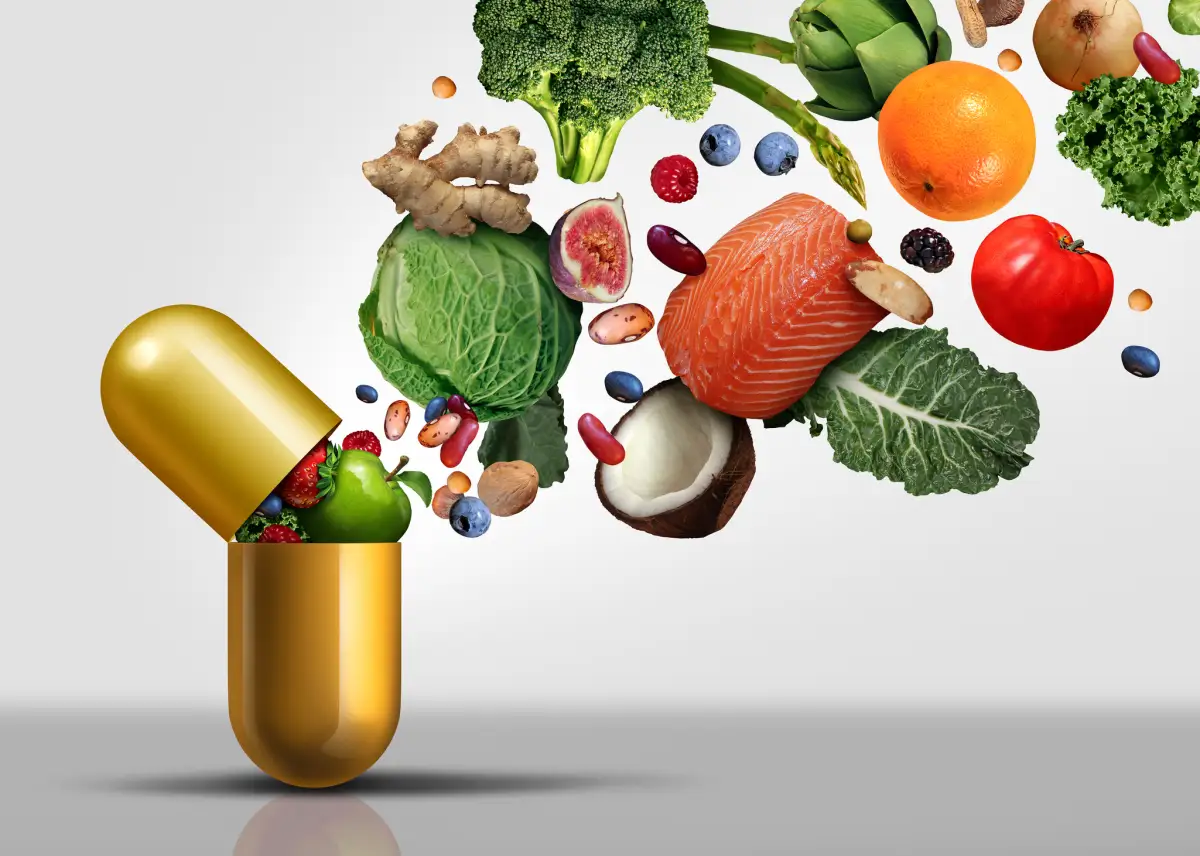
Nutraceutical, a portmanteau of the words “nutrition” and “pharmaceutical”, is a food or food product that provides health and medical benefits, including the prevention and treatment of disease. Health Canada defines the term as “a product isolated or purified from foods that is generally sold in medicinal forms not usually associated with food.
A nutraceutical is demonstrated to have a physiological benefit or provide protection against chronic disease.”Such products may range from isolated nutrients, dietary supplements and specific diets to genetically engineered foods, herbal products, and processed foods such as cereals, soups, and beverages.
With recent developments in cellular-level nutraceutical agents, researchers, and medical practitioners are developing templates for integrating and assessing information from clinical studies on complementary and alternative therapies into responsible medical practice.
Nutraceutical products used to be considered alternative medicine, but now research has been showing the importance of nutraceuticals to our everyday diet. New studies conducted by food scientists have show that there is more to food science than what was understood just a couple decades ago.
The term nutraceuticals was first coined by a man named Dr. Stephen L. DeFelice and is formed by combining the words “nutrition” and “pharmaceutical”. The Merriam-Webster Dictionary defines nutraceutical as “A food stuff (as a fortified food or a dietary supplement) that provides health benefits.” In a nutshell, nutraceuticals are foods or food products with some type of health benefit, including the prevention and treatment of disease. Dietary supplements are found in many different forms such as tablets, capsules, soft-gels, gel-caps, liquids, or powders. Some of the ingredients in these products can consist of: vitamins, minerals, amino acids, and substances such as organ tissues, enzymes, glandular tissues, and metabolites. All of Swiss Sciences Nutrition’s products are made through manufacturing processes that are medical grade facilities such as NHK and NULAB facilities.
Carotenoids like beta carotene, present in carrots have antioxidant properties, by virtue of which they neutralize free radicals and prevent cellular damage. Lycopene, found in tomatoes, is known to help in the maintenance of prostatic health. Tree nuts are rich in monosaturated fatty acids, which offer some protection against coronary heart disease. Flavonols present in tea, onions, broccoli, and apples are known to have anti-aging effects as they slow down the degenerative processes in the body. Isothiocyanates like sulforaphane, found in horseradish, cabbage, cauliflower, kale, and broccoli, are known to facilitate the detoxification of harmful substances within the human body.
Phenols such as caffeic acid and ferulic acid, present in citrus fruits, pears, apples, and certain vegetables, can help to maintain good vision and a healthy heart. Some dietary supplements contain plant stanols or sterols, both of which have cardio-protective properties. Sugar alcohols like sorbitol, lactitol, xylitol, and mannitol, used in some chewing gums, may reduce the chances of developing dental caries. Probiotics like lactobacilli, present in curds, are known to improve gastrointestinal health and boost the body’s immunity in general. Isoflavones like daidzein and genistein, present in soybeans, are phytoestrogens that can help to relieve the symptoms of menopausal syndrome in older women.
So, here are common mistruths that you need to know about supplements:
- Natural means they are risk free: Everything comes with risk and there are many natural substances that will kill you. So don’t make the mistake of assuming that just because a supplement is labeled as natural that it’s safe for you.
- Supplements are tested over and over again: Companies are under no pressure to test their products. After all, it’s on the governments shoulders to prove that a supplement is unsafe. Thus, supplement companies can use the general public as guinea pigs.
- Supplements are backed by all sorts of studies: Most of the charts and graphs you see on the bottles are manufactured. Even worse, they are performed by the same companies selling the products. And this is a perfect breeding ground for conflicts of interest.
- Supplement companies have your best interest in mind: There is always going to be a constant struggle between quality and profit. And some companies worry more about the profit side of the equation. So don’t assume that a nicely packaged bottle of pills is “safe.”
- High intakes of fish fats are optimal: Fish oil is healthy for you, but giant intakes are not. You see, if you start having more than three grams a day, you run the risk of heart damage. More is not better here, even with fish oil.
- More is better: Not only is taking mega doses of vitamins potentially toxic, but it can interfere with other medications you may be taking. There have been countless cases of people who unknowingly stack up on vitamin pills that have lethal interactions with their medications.
Classification of Nutraceuticals
Nutraceuticals is a broad umbrella term used to describe any product derived from food sources that provides extra health benefits in addition to the basic nutritional value found in foods. Products typically claim to prevent chronic diseases, improve health, delay the aging process, and increase life expectancy.
Dietary Supplements
Dietary supplements, such as the vitamin B supplement show above, are typically sold in pill form.
A dietary supplement is a product that contains nutrients derived from food products that are concentrated in liquid or capsule form. The Dietary Supplement Health and Education Act (DSHEA) of 1994 defined generally what constitutes a dietary supplement. “A dietary supplement is a product taken by mouth that contains a “dietary ingredient” intended to supplement the diet. The “dietary ingredients” in these products may include: vitamins, minerals, herbs or other botanicals, amino acids, and substances such as enzymes, organ tissues, glandulars, and metabolites. Dietary supplements can also be extracts or concentrates, and may be found in many forms such as tablets, capsules, softgels, gelcaps, liquids, or powders.”
Functional Foods
Functional foods are designed to allow consumers to eat enriched foods close to their natural state, rather than by taking dietary supplements manufactured in liquid or capsule form. Functional foods have been either enriched or fortified, a process called nutrification. This practice restores the nutrient content in a food back to similar levels from before the food was processed. Sometimes, additional complementary nutrients are added, such as vitamin D to milk.
Medical Foods
Medical foods aren’t available as an over-the-counter product to consumers. The FDA considers medical foods to be “formulated to be consumed or administered internally under the supervision of a physician, and which is intended for the specific dietary management of a disease or condition for which distinctive nutritional requirements, on the basis of recognized scientific principles, are established by medical evaluation.” Nutraceuticals and supplements do not meet these requirements and are not classified as Medical Foods.
Farmaceuticals
According to a report written for the United States Congress entitled “Agriculture: A Glossary of Terms, Programs, and Laws”, “(Farmaceuticals) is a melding of the words farm and pharmaceuticals. It refers to medically valuable compounds produced from modified agricultural crops or animals (usually through biotechnology). Proponents believe that using crops and possibly even animals as pharmaceutical factories could be much more cost effective than conventional methods (i.e., in enclosed manufacturing facilities) and also provide agricultural producers with higher earnings.