

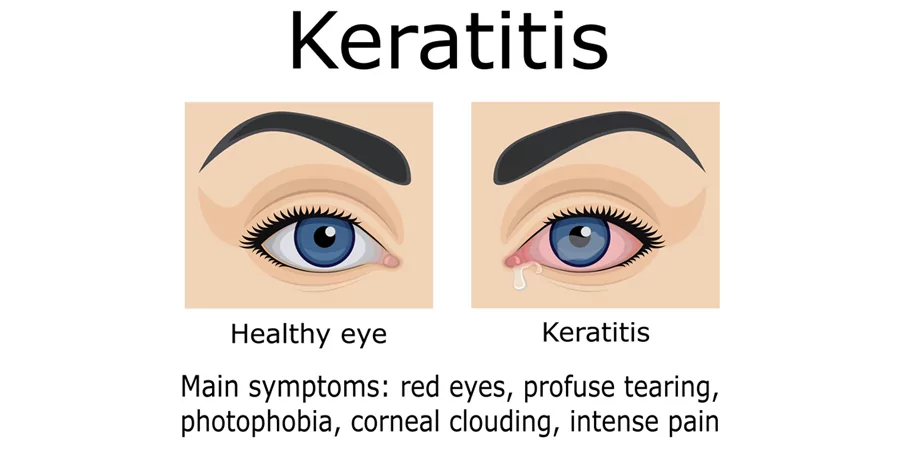
Keratitis is an inflammation (swelling) of the cornea. The cornea is the thin, colorless covering in the front of the eye. It protects the iris (colored part of the eye) and pupil (opening of the eye where light passes through). Keratitis may be ulcerative (open sores) or non-ulcerative (no sores), and is commonly caused by an infection. It usually affects one eye but can sometimes affect both eyes. It is a serious problem that may result in loss of vision due to scarring of the cornea.
Types of Keratitis:
There are several types of keratitis:
- Ulcerative keratitis will be caused most likely by an eye injury.
- Chronic degenerative keratitis is more common in certain breeds (i.e., Siamese), so it is believed to be caused by genetic factors or frequent eye infections.
- Eosinophilic keratitis is a condition that starts as keratitis, but it evolves further until the cornea gets a pinkish hue and the affected eye is covered by a white film.
Causes of Keratitis:
Keratitis is the swelling and irritation of the cornea, the protective layer of the eyeball. The condition can dry the cornea and for this reason, it is also known as ‘dry eye.’
The causes of keratitis are not precisely determined, but certain factors may be suspected:
- The feline herpes virus
- A foreign object that reaches the cornea
- An eye injury
- An eye infection
The condition may be more common in certain cat breeds, so a few genetic factors may also contribute to the occurrence of keratitis.
Symptoms:

Symptoms of keratitis include:
- Red eye
- Sensation of something, like sand, in the eye
- Pain
- Sensitivity to light
- Watery eye
- Blurred vision
- Difficulty keeping the eyelids open
The symptoms described above may not necessarily mean that you have keratitis. However, if you experience one or more of these symptoms, contact your eye doctor for a complete exam.
Diagnosis of Keratitis:
A slit-lamp examination reveals the depth of the keratitis. If keratitis is due to herpes simplex virus, staining the eye with a fluorescein strip produces one or more small branch like (dendritic) lesions; touching the cornea with cotton reveals reduced corneal sensation. Vision testing may show slightly decreased acuity. The patient history may reveal a recent infection of the upper respiratory tract accompanied by cold sores.
Complications of Keratitis:
The list of complications that have been mentioned in various sources for Keratitis includes:
- Corneal ulcer
- Loss of sight – mainly from the bacterial type
- Blindness
Treatment:
Treatment of keratitis depends upon the cause. If there is mild injury to the cornea, such as a scratched cornea, no specific treatment is necessary. An antibiotic ointment might be prescribed. This is done mostly for comfort.
You may have any of the following:
Medicines:
Antibiotics: This medicine is given to help treat or prevent an infection caused by bacteria.
Antifungal medicine: This medicine helps kill fungus that can cause illness.
Antiparasitic medicine: This medicine may be given to kill parasites. Parasites are living things that feed or eat off of other living things.
Antiviral medicine: Antiviral medicine may be given to fight an infection caused by a germ called a virus.
Steroids: Steroid medicine may be given as an eyedrop to decrease inflammation in your eye.
Surgery: You may need to have surgery if your cornea is badly damaged. A cornea from a donor may be put into your eye to replace the damaged part of your cornea.
With treatment, such as medicine, more serious problems of keratitis may be prevented.
Prevention of Keratitis:
- Many cases of keratitis could be avoided with common sense and good hygiene. Protecting your cornea from cuts with sports and protective eyewear is the first step, since keratitis also results from a corneal injury. If you have a cold sore or genital herpes , avoid touching your eyes – and avoid over-the-counter steroid eye drops, which can worsen this type of infection.
- Children and adults who wear contact lenses should always use sterile lens-cleaning and disinfecting solutions.
- Do not over wear contact lenses at night and remove them if the eyes become red or irritated.
- Also consume a well-balanced diet, including vitamin A- rich foods such as carrots, squash, mangoes, sweet potatoes and spinach.