
Close Menu
Health Today
    Latest Articles

    Anna Faris Workout And Diet

    The Definitive MOTS-C Dosing Guide: Protocol for Fat Loss and Performance

    What is GHK-Cu? The Ultimate Guide to Benefits, Dosing, and Uses

    How Trans Fat Increase Our Cholesterol

    Cardiovascular Cost: How Steroids Permanently Damage Your Heart

    The Endocrine Aftermath: Could You Be on TRT for Life?

    Facebook X (Twitter) Instagram
    X (Twitter) Pinterest Vimeo Mastodon
    Health Today
    • Home
    • Bodybuilding
      1. Anabolic Steroids
      2. Peptides
      3. Workouts
      4. View All

      Cardiovascular Cost: How Steroids Permanently Damage Your Heart

      December 10, 2025

      The Endocrine Aftermath: Could You Be on TRT for Life?

      December 10, 2025

      Natural Maximization: How to Optimize Your Testosterone Without Drugs

      December 10, 2025

      SARMs vs. Steroids: A Clear-Eyed Comparison of Risks and Promises

      December 10, 2025

      The Definitive MOTS-C Dosing Guide: Protocol for Fat Loss and Performance

      December 11, 2025

      What is GHK-Cu? The Ultimate Guide to Benefits, Dosing, and Uses

      December 11, 2025

      Hexarelin Explained: The Most Potent GHRP

      December 9, 2025

      Peptides for Cutting: Is Retatrutide the Final Boss?

      December 9, 2025

      Nargis Fakhri Workout And Diet

      January 14, 2021

      Alicia Keys Workout And Diet

      January 12, 2020

      Aamir Khan Workout And Diet

      April 11, 2012

      Celine Dion Workout And Diet

      April 9, 2012

      The Definitive MOTS-C Dosing Guide: Protocol for Fat Loss and Performance

      December 11, 2025

      What is GHK-Cu? The Ultimate Guide to Benefits, Dosing, and Uses

      December 11, 2025

      Cardiovascular Cost: How Steroids Permanently Damage Your Heart

      December 10, 2025

      The Endocrine Aftermath: Could You Be on TRT for Life?

      December 10, 2025
    • Celebs

      Anna Faris Workout And Diet

      January 12, 2026

      Nargis Fakhri Workout And Diet

      January 14, 2021

      Alicia Keys Workout And Diet

      January 12, 2020

      Aamir Khan Workout And Diet

      April 11, 2012

      Celine Dion Workout And Diet

      April 9, 2012
    • Common Disease
      1. Anemia
      2. Cellulitis
      3. Cold & Flu
      4. Dizziness
      5. Genital Herpes
      6. Hookworm
      7. Impetigo
      8. Influenza (Flu)
      9. Keratitis
      10. Malaria
      11. Mastitis
      12. Measles
      13. Meningitis
      14. Mumps
      15. Pneumonia
      16. Sinusitis
      17. Sore Throat
      18. Stomatitis
      19. Warts
      20. View All

      Anemia: Its Causes, Sign And Symptoms, Diagnosis And Treatment

      December 11, 2011

      Cellulitis: Its Causes, Symptoms, Complications And Treatments

      December 10, 2011

      Dizziness: Its Types, Causes, Symptoms And Treatment

      December 11, 2011

      Genital Herpes: Its Causes, Symptoms, Diagnosis And Treatment

      December 11, 2011

      Hookworm: Its Causes, Symptoms, Tests And Treatment

      December 10, 2011

      Impetigo: Its Types, Causes, Risk Factors, Symptoms And Treatment

      December 11, 2011

      Influenza: Its Causes, Symptoms, Diagnosis And Treatments

      December 9, 2011

      Keratitis: Its Types, Causes, Symptoms, Diagnosis And Treatment

      December 12, 2011

      Malaria: Its Types, Causes, Risk Factors, Symptoms And Treatment

      December 10, 2011

      Mastitis: Its Types, Causes, Symptoms, Diagnosis And Treatment

      December 12, 2011

      Measles: Its Types, Causes, Symptoms And Treatment

      December 12, 2011

      Meningitis: Its Causes, Symptoms, Diagnosis And Treatment

      December 10, 2011

      Mumps: Its Causes, Symptoms, Complications And Treatment

      December 10, 2011

      Sinusitis: Its Causes, Risk Factors, Symptoms, Tests And Treatment

      December 12, 2011

      Sore Throat: Its Types, Causes, Symptoms, Diagnosis And Treatment

      December 10, 2011

      Stomatitis: Its Types, Causes, Symptoms And Treatment

      December 12, 2011

      Warts: Its Types, Causes, Symptoms And Treatment

      December 11, 2011

      Sinusitis: Its Causes, Risk Factors, Symptoms, Tests And Treatment

      December 12, 2011

      Keratitis: Its Types, Causes, Symptoms, Diagnosis And Treatment

      December 12, 2011

      Mastitis: Its Types, Causes, Symptoms, Diagnosis And Treatment

      December 12, 2011

      Stomatitis: Its Types, Causes, Symptoms And Treatment

      December 12, 2011
    • Lifestyle

      Top 9 Secrets of Happiness

      April 9, 2012

      A To Z Steps of Motivation

      December 11, 2011
    Contact
    Health Today
    You are at:Home » Types of Weight Loss Surgery
    Weight Loss

    Types of Weight Loss Surgery

    By Doc. MiDecember 7, 2011Updated:December 11, 2025No Comments5 Mins Read1 Views
    Facebook Twitter Pinterest Telegram LinkedIn Tumblr Email Reddit
    Share
    Facebook Twitter LinkedIn Pinterest WhatsApp Email

    Weight loss surgery, also referred to as a bariatric surgery, can be described as a surgery is one option of treatment for people who want to slim down. However, it is not a solution for everyone, but usually it is meant for people who are borderline obese or obese.

    Common Types Of Weight Loss Surgeries:

    When it comes to a decision about the actual type of weight loss surgery to be used, there are a couple of different surgical procedures that can be used.

    1. Laparoscopic Gastric Banding (Lap-Band)
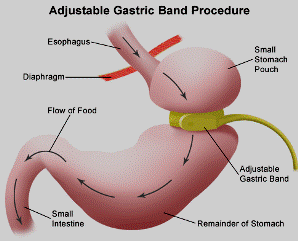
    An inflatable band is placed around the upper stomach to create a small pouch and narrow passage into the remainder of the stomach. This limits food consumption and creates an earlier feeling of fullness. Once the band is in place, it is inflated with saline. The band is adjusted over time by increasing or decreasing the amount of salt solution to change the size of the passage. The band is intended for severely obese people — those at least 100 pounds overweight or who are at least twice their ideal body weight — who have failed to lose weight by other methods such as a supervised diet and exercise. The band is intended to remain in place permanently, but it can be removed if necessary. People who get the band will need to diet and exercise in order to maintain their weight loss. Complications may include nausea and vomiting, heartburn, abdominal pain, band slippage, or pouch enlargement.

    2. Roux-en-Y Gastric Bypass (RGB)
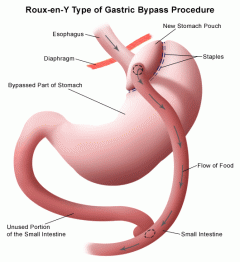
    The surgeon makes the stomach smaller by using surgical staples to create a small stomach pouch. The pouch is attached to the middle part of a small intestine. Food bypasses the upper part of the small intestine and stomach and goes into the middle part of the small intestine through a small opening. Bypassing the stomach limits the amount of food a person can eat. By bypassing part of the intestine, the amount of calories and nutrients the body absorbs is reduced. The small opening slows down the rate food leaves the pouch. One risk for patients is “dumping syndrome.” This happens when the stomach contents move too rapidly through the small intestine. Symptoms may include nausea, weakness, sweating, faintness, and diarrhea after eating. Side effects include infection, leaking, pulmonary embolism (sudden blockage in a lung artery), gallstones, and nutritional deficiency.

    3. Biliopancreatic Diversion (BPD)
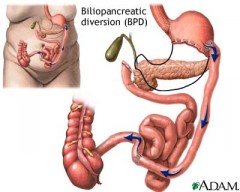
    This procedure is not commonly used in the United States. A large part of the stomach is removed. The amount of food is restricted, in addition to stomach acid production. The small pouch that remains is connected directly to the final segment of the small intestine, completely bypassing other parts of the small intestine. A common channel remains in which bile and pancreatic digestive juices mix prior to entering the colon. Weight loss occurs since most of the calories and nutrients are routed into the colon where they are not absorbed. This procedure is less frequently used than other types of surgery because of the high risk for nutritional deficiencies. A variation of BPD includes a “duodenal switch,” which leaves a larger portion of the stomach intact, including the pyloric valve that regulates the release of stomach contents into the small intestine. It also keeps a small part of the duodenum.

    4. Vertical Banded Gastroplasty (VBG)
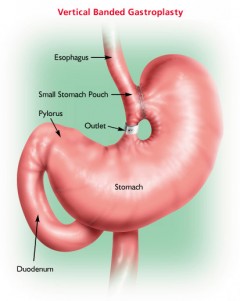
    The vertical banded gastroplasty or VBG is a restrictive gastric (stomach) bypass surgery for weight loss surgery. The vertical banded gastroplasty for weight loss, along with the Roux en Y gastric bypass surgery, is one of the two major types of operations for the treatment of severe obesity. The goal of this procedure is to severely restrict the patient’s capacity to eat certain foods. The general or bariatric surgeon uses sophisticated surgical staples to make a small stomach pouch. This reduces how much food the stomach can hold. When the amount of food the stomach can hold is reduced, an obese person feels full sooner. But at the same time, the stomach digests nutrients and calories in a normal anatomical way. This is another common way to reduce how much food the stomach can hold. Vertical banded gastroplasty has an advantage by limiting only the amount of the food meal, and not affecting the absorption process involved in digestion.

    5. Laparoscopic Sleeve Gastronomy
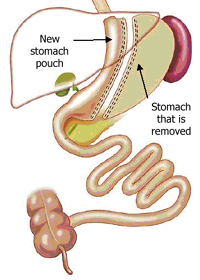
    It is a restrictive procedure; by reducing the stomach capacity, the patient feels full after a small intake of food. Sleeve gastrectomy is a surgical weight-loss procedure in which the stomach is reduced to about 25% of its original size, by surgical removal of a large portion of the stomach, following the major curve. The open edges are then attached together (often with surgical staples) to form a sleeve or tube with a banana shape. The procedure permanently reduces the size of the stomach. The procedure is performed laparoscopically and is not reversible. It is done by means of laparoscopic techniques. These techniques involve the use of special instruments that are introduced through very small incisions that allow the area treated to be seen on a closed circuit monitor. The incisions that the surgeons make nowadays are of no more than 0.4 inches (1 cm); the surgical trauma they produce is much lower and the post surgical pain much more tolerable. Through these incisions, the surgeon can reach the stomach and, using a special stapler, he makes a vertical suture to divide the stomach in two. One of the sections is shaped like a tube that goes from the esophagus to the intestine. The other one is separated and removed. The staples used are very strong.

    You Might Also Like:

    Weight Loss Surgery: Its Need, Preparations, Benefits And Complications

    Share. Facebook Twitter Pinterest LinkedIn Reddit WhatsApp Telegram Email
    Previous ArticlePistachios Health Benefits
    Next Article Weight Loss Surgery: Its Need, Preparations, Benefits And Complications
    Doc. Mi
    • Website

    Doc. Mi is a seasoned health and performance specialist dedicated to translating complex medical science into actionable strategies for bodybuilders and athletes. With a focus on evidence-based nutrition, supplementation, and injury prevention, he provides the clear, trusted insights needed to achieve peak physical results and long-term wellness.

    Related Posts

    The Definitive MOTS-C Dosing Guide: Protocol for Fat Loss and Performance

    December 11, 2025

    How Trans Fat Increase Our Cholesterol

    December 11, 2025

    Tesamorelin Explained: The Peptide That Targets Stubborn Belly Fat

    December 8, 2025
    Leave A Reply Cancel Reply

    bodypharm partner banner
    Top Posts

    Aamir Khan Workout And Diet

    April 11, 201229 Views

    Livagen Peptide: Boost Cellular Health and Slow Aging

    December 3, 202528 Views

    Low Blood Pressure Causes, Symptoms and Tests

    January 12, 202121 Views

    What is GHK-Cu? The Ultimate Guide to Benefits, Dosing, and Uses

    December 11, 202519 Views
    Don't Miss
    Celebs January 12, 2026

    Anna Faris Workout And Diet

    Anna Kay Faris (born November 29, 1976) is an American actress, singer and comedienne. She…

    The Definitive MOTS-C Dosing Guide: Protocol for Fat Loss and Performance

    What is GHK-Cu? The Ultimate Guide to Benefits, Dosing, and Uses

    How Trans Fat Increase Our Cholesterol

    Stay In Touch
    • Twitter
    • Pinterest
    • Vimeo
    • Mastodon
    About Us
    About Us

    Health-Today provides science-backed fitness and health strategies for dedicated men. We translate complex research into clear, actionable guides on training, nutrition, and wellness, empowering athletes and bodybuilders to achieve peak performance.

    Facebook X (Twitter) Pinterest YouTube WhatsApp
    Our Picks

    Anna Faris Workout And Diet

    The Definitive MOTS-C Dosing Guide: Protocol for Fat Loss and Performance

    What is GHK-Cu? The Ultimate Guide to Benefits, Dosing, and Uses

    Most Popular

    HCG Weight Loss Program Proved Its Benefits

    August 8, 20111 Views

    The Basics Of Acne (Pimples) And Its Causes

    August 15, 20111 Views

    Watermelon: A Natural Tip to Get Rid of Acne

    August 18, 20111 Views
    © 2011 - 2026 Health-Today.org. All content, branding, and materials are protected. The information on this website is for educational and informational purposes only; it is not medical advice. Always consult a healthcare professional.
    • Home
    • About Us
    • Medical Disclaimer
    • Editorial Standards
    • Affiliate Disclosure

    Type above and press Enter to search. Press Esc to cancel.