

Alzheimer’s disease (AD) changes the lives of not only the people diagnosed with the condition, but also the friends and family members close to them.
An incurable, progressive form of dementia,Alzheimer’s disease is one of the most serious and progressive forms of mental deterioration known as dementia, Alzheimer’s impacts a part of the brain that controls cognitive function, including memory, comprehension, thought processing, and language capabilities. All people who develop Alzheimer’s disease become unable to care for themselves once the condition reaches its final stages.
Alzheimer’s disease is the most common cause of dementia among older people. Dementia is the loss of cognitive functioning—thinking, remembering, and reasoning—and behavioral abilities, to such an extent that it interferes with a person’s daily life and activities. Dementia ranges in severity from the mildest stage, when it is just beginning to affect a person’s functioning, to the most severe stage, when the person must depend completely on others for basic activities of daily living.
Alzheimer’s disease is named after Dr. Alois Alzheimer. In 1906, Dr. Alzheimer noticed changes in the brain tissue of a woman who had died of an unusual mental illness.
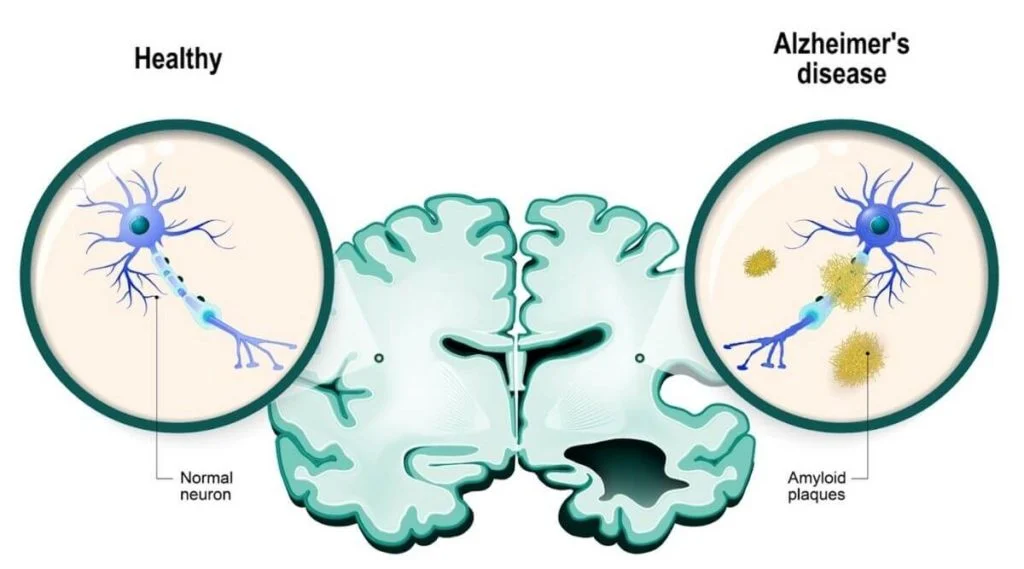
Her symptoms included memory loss, language problems, and unpredictable behavior. After she died, he examined her brain and found many abnormal clumps (now called amyloid plaques) and tangled bundles of fibers (now called neurofibrillary tangles). Plaques and tangles in the brain are two of the main features of Alzheimer’s disease. The third is the loss of connections between nerve cells (neurons) in the brain.

Different Stages of Alzheimer’s disease progression
- Early Stage Alzheimer’s disease Memory problems are one of the first signs of AD. Some people with memory problems have a condition called amnestic mild cognitive impairment (MCI). People with this condition have more memory problems than normal people of their age, but their symptoms are not as severe as those of AD, and they are able to carry out their normal daily activities.
More people with MCI, compared with those without MCI, go on to develop Alzheimer’s. - Mild Alzheimer’s disease As Alzheimer’s disease progresses, memory loss continues and changes in other cognitive abilities appear. Problems can include getting lost, trouble handling money and paying bills, repeating questions, taking longer to complete normal daily tasks, poor judgment, and small mood and personality changes. People often are diagnosed in this stage.
- Moderate Alzheimer’s disease In this stage, damage occurs in areas of the brain that control language, reasoning, sensory processing, and conscious thought.
Memory loss and confusion increase, and people begin to have problems recognizing family and friends. They may be unable to learn new things, carry out tasks that involve multiple steps (such as getting dressed), or cope with new situations. They may have hallucinations, delusions, paranoia, and may behave impulsively. - Severe Alzheimer’s disease By the final stage, plaques and tangles have spread throughout the brain, and brain tissue has shrunk significantly. Patients cannot communicate and are completely dependent on others for their care. Near the end, the person may be in bed most or all of the time as the body shuts down.